- The Tech Buzz
- Posts
- Anthropic x SpaceXAI Cloud Compute
Anthropic x SpaceXAI Cloud Compute
Terafab $1.4B Fab build + Orbital Data Centers + OpenAI Safety Under Fire

The Tech Buzz
May 08, 2026
IN PARTNERSHIP WITH

WHAT’S INSIDE:
Feature: Anthropic Taps SpaceXAI for Cloud Compute
Top Tech News: Iran-war active again, oil volatility; Trump rhetoric cools, Stocks hit records then fade; tariffs ruled illegal; jobs data mixed as layoffs rise.
Company Watch: Kalshi $22B; a16z crypto $2.2B; Cloudflare -1,100; Asia AI shifts east; Moonshot AI $2B; Linkerbot targets $6B.
Buzzy Tools: Anthropic finance agents; Claude managed agents; Google “Remy”; Interact AI websites.
Buzzy Tech: Charity-name token scams; ultra-long “water battery”; new cancer targets; fusion laser advance; quantum materials leap.
Crypto: SEC pauses prediction ETFs; DTCC tokenization; AWS micropayments; XRPL treasury settlement; E*TRADE crypto; BitMart card; Bitwise–Superstate.
IN PARTNERSHIP WITH ATTIO
This is how the top 1% of startups scale.
GTM Atlas is a free resource by Attio, the CRM of the modern GTM stack. With stories and insights from leading operators at Framer, Lovable, and Vercel, you’ll get:
ICP, outbound, and retention frameworks from operators who've built them
The qualification signals that actually predict conversion
Conversion plays that don't rely on a pitch deck
Mapped by operators. Curated by Attio.

Top Technology News
Markets Hit Records — S&P 500, Nasdaq futures hit record highs before closing down on resumed Iran-US strikes, oil prices rebounded despite Trump claims a deal is still possible.
Tariffs Struck Down — A panel of federal judges on the Court of International Trade voted that President Trump’s 10% tariffs on most US imports are illegal.
Jobs Report Mixed — Despite rising layoff announcements (incl. Coinbase, Cloudflare) the upcoming jobs report data suggests a potential upswing in hiring and sliding job demand.
Oil Bets $7B — Traders placed large bets on oil prices before news of potential conflict with Iran with report prompting significant insider trading claims.

Elon Sides With Safety in Anthropic Deal
Tech Buzz Editorial Feature
This week, Elon stopped training models and started selling atoms. We explore how 300 Megawatts and an his Evil Detector rewired the AI race.
Musk's Bet on Anthropic Just Broke OpenAI's Monopoly Dreams.
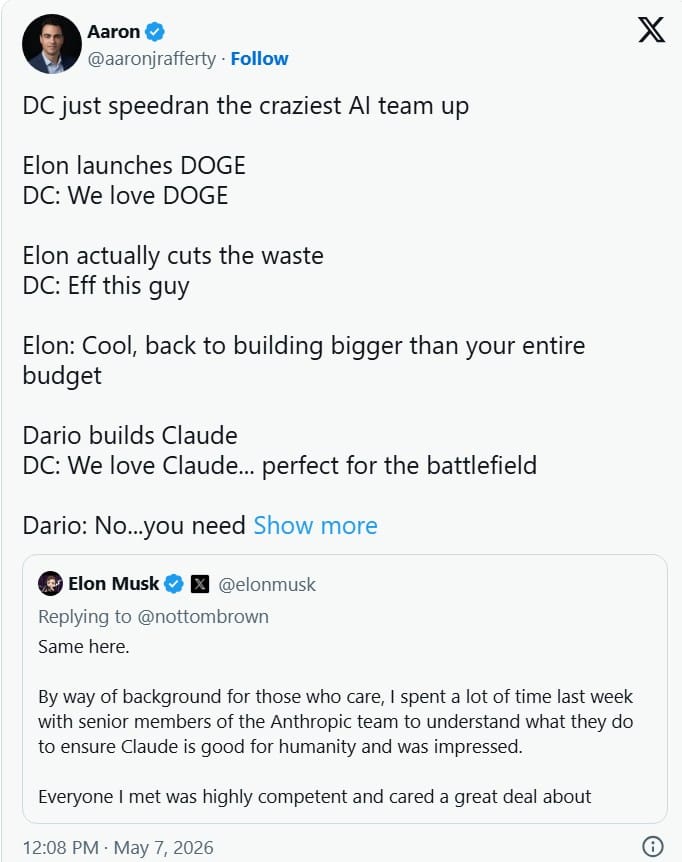
Last week, Elon Musk spent serious time with Anthropic's senior team doing something unusual: checking if they passed his internal moral litmus test. "No one set off my evil detector," he posted on X afterward, before announcing that SpaceX would lease all 300 megawatts of computing capacity at its Colossus 1 data center in Memphis to Claude's parent company. The move doubled Claude Code's usage limits overnight and handed Anthropic the infrastructure to compete with labs that have 10x its fundraising total.
This is the same Elon who called Anthropic "misanthropic" three months ago. The same guy suing OpenAI and Sam Altman in federal court for allegedly abandoning their founding mission to build safe AGI.
Things have moved on, as Anthropic recently demanded guardrails for military AI use and lost out on lucrative military and government contracts to OpenAI and Palantir for holding to this moral line. It makes total sense now that Musk is bankrolling Anthropic with billions of dollars worth of GPU time.
The partnership boosts Anthropic's compute budget. But, more importantly, it validates a specific approach to AI development at exactly the moment OpenAI's version is getting shredded under oath. While Rosie Campbell, a former OpenAI safety researcher, testified in Oakland about how the company disbanded her AGI readiness team and pushed GPT-4 into production before safety reviews were complete, Anthropic announced capacity increases funded by the world's richest technologist. The optics are brutal, and they matter. Capital follows credibility, and credibility just switched camps.
From Rocket Fuel to Cloud Revenue
The Colossus deal reveals something bigger than a compute transaction. xAI, which SpaceX acquired earlier this year, is acting less like a hybrid foundation model lab and more like a next-generation cloud provider. Musk confirmed his team had already moved AI training to Colossus 2, meaning the first facility became available inventory the moment it went live. That calculation, leasing out 220,000 Nvidia GPUs instead of hoarding them for in-house model development, puts xAI in a different category than Google or Meta.
Those companies are capacity constrained by choice. Sundar Pichai admitted last month that Google Cloud revenue fell short because the company prioritized internal AI products over customer workloads. Mark Zuckerberg spun up an entirely new cloud infrastructure, Meta Compute, just to guarantee his AI ambitions wouldn't get bottlenecked by someone else's rental inventory. The strategic logic is ironclad: compute powers the products that dominate the next decade, so you build your own no matter the cost.
Musk is taking the opposite bet. Instead of locking up GPUs for Grok or some unreleased xAI product, he's positioning SpaceX as the picks-and-shovels play. Lease the infrastructure, charge market rates, let other labs burn capital training models. It's a neocloud strategy, and it comes with neocloud economics. CoreWeave, which operates comparable GPU capacity, is valued at under $80B. xAI's January funding round valued the combined entity at $230B. That gap exists because markets still believe xAI is building frontier models, not renting out server racks.
Musk's Terafab Targets $119B - 1TW Chip Compute Fab
The economics got even more interesting when SpaceX filed paperwork in Grimes County, Texas for an initial $55B semiconductor fab for Terafab, xAI's chip play. Rather than wait on TSMC and Samsung capacity, the fab will potentially scale to $119B over multiple phases, built with Tesla resources and Intel as manufacturing partner. The project is sized for his stated goal of producing enough chips for 1 Terawatt of compute annually, supplying xAI servers, satellites, autonomous Tesla vehicles, robots, and orbital data centers.
Building proprietary silicon doesn't eliminate Nvidia dependency completely, but it does crack their pricing power on the supply side. Most neoclouds are squeezed from both ends: chip suppliers set prices upstream, demand cycles swing wildly downstream. If xAI can fabricate 1TW of its own processors, the margin structure for renting compute changes fundamentally. It’s no longer just a middleman passing through Nvidia's markup. It’s now capturing value that currently flows to Santa Clara.
But here's the tension: chip fabs are capital black holes that take years to scale, and selling compute to competitors like Anthropic means xAI won't have that capacity available for the long-horizon software projects that actually justify a $230B valuation. The more successful the landlord business becomes, the less runway exists for building products that escape commodity economics. Unless the real product is the infrastructure itself, and everything else is a proof of concept to justify the buildout.
And, it just gets worse for OpenAI, The Information just reported that an internal memo has warned of financing gaps in the company's $18 billion AI chip program.
Orbital Ambitions and the Power Ceiling
The SpaceX/Anthropic partnership also includes a longer play that sounds like science fiction but is being discussed in the same boardrooms pricing terrestrial real estate. Anthropic and SpaceX are exploring the development of multi-gigawatt orbital data centers, spacecraft equipped with AI processors that run inference workloads in low Earth orbit. The idea solves a problem that's already showing up in earnings calls: AI demand for electricity is outpacing what ground-based infrastructure can deliver. Data centers need power, and power grids in every developed economy are hitting capacity limits.
Space offers effectively unlimited solar energy and none of the permitting constraints that slow terrestrial builds. SpaceX is already winding down Falcon 9 launches at Cape Canaveral to make room for Starship operations, and those Starships are being built to haul payloads that dwarf anything currently flying. If the rocket economics work, and SpaceX has a better track record than anyone at making rocket economics work, orbital becomes a plausible answer to the question every AI lab is facing: where do we get the next 100 gigawatts?
Startups are already circling the opportunity. Star Catcher is building power-beaming constellations to feed energy to satellites using existing solar arrays. Lux Aeterna is developing reusable spacecraft designed for high-cadence hardware swaps, treating orbital platforms more like server racks you rotate than satellites you launch and forget. The infrastructure layer is forming before the primary use case has even launched, which means the investors and operators pricing terrestrial data center assets might want to start modeling what happens if a meaningful percentage of AI compute moves off-planet by 2030.
Anthropic Finance Destroys Microsoft’s Enterprise AI Play
While the Colossus headlines grabbed attention, Anthropic also shipped something that directly threatens Microsoft's two-year head start in enterprise AI. Ten prebuilt finance agents went live Tuesday across Claude Cowork, Claude Code, and Claude Managed Agents, automating the grunt work that eats junior analysts alive: pitchbooks, KYC files, month-end close, earnings reviews, GL reconciliation. Goldman Sachs, JPMorgan, and Citi have been running them in production for months. Citadel, BNY, Carlyle, Mizuho, Travelers, and Hg signed on this week.
Microsoft spent 24 months trying to make Copilot sticky and just lost OpenAI exclusivity. Google has chips and cloud but no prebuilt workflows pointed at actual enterprise pain points. Anthropic packaged the models with data connectors from Moody's, Dun & Bradstreet, and IBISWorld, then launched a joint venture with Blackstone, Hellman & Friedman, and Goldman to deploy the whole stack into mid-market companies that have never had access to this kind of tooling.
That last part, the PE-backed delivery mechanism, might be the most important piece. Model performance is becoming commoditized faster than any lab wants to admit. The labs that win are the ones that figure out distribution, and distribution in enterprise software means showing up with financing, integrations, and a team that actually installs the product. Anthropic built all three in a single announcement.
“Mira is Cool”
Three days after validating Anthropic, Musk posted two words on X: "Mira is cool." Mira Murati left OpenAI after involvement in expressing safety concerns during the Sam Altman (as a Microsoft proxy) leadership challenge. She then launched Thinking Machines Lab a stealth lab focused on physical AI and world models, and now has the richest person in technology signaling interest during the same week he's exposing OpenAI’s safety practices in federal court. If Murati's team gets Colossus 2 compute, access to SpaceX's robotics ambitions through Optimus, and Anthropic's safety credibility, that triangle could redefine who wins physical AI. It's speculative, but it's the kind of speculation that moves billions of dollars when the pieces fit this cleanly.
Companies To Watch
Latest deals and trending companies
Open Deal
Parallel Web — Ex Twitter CEO Parag Agrawal founded startup offers web search, research APIs for AI agents is raising $100M Series B at $2B valuation with total funding reaching $230M serving Notion, Opendoor with 100K+ developers.
Big Movers
Kalshi $1B — The SF-based prediction market platform closed a new round boosting valuation to $22B, poised for rapid growth as it expands market offerings.
a16z Crypto $2.2B — Raised for fifth crypto-focused fund deliberately smaller than previous $4.5B with strategy aiming for shorter fundraising cycles aligning with evolving crypto trends.
Cloudflare Cuts — San Francisco web performance, security company announced cut of over 1,100 jobs to streamline operations with strong ARR growth.
Asia AI Rise — Asia tech giants including Tencent, Alibaba are becoming central to the global AI boom with investments, innovations shifting industry center of gravity eastward.
Moonshot AI $2B — China-based open-source AI platform raised at $20B valuation reflecting rapid growth poised to capitalize on surging demand positioning itself as leader in open-source AI space.
Linkerbot $6B — Chinese robotics startup targets valuation while scaling market-leading robotic hands to 10K units/month supported by Alibaba Ant Group.
Buzzy Tools & Tech
The Latest Trending Tools & Cutting Edge Technology Developments
Buzzy Tools
Buzzy Tools To Watch and Try Today
Anthropic Finance — Ten financial agent templates automate workflows with real-time data in MS 365.
Claude Managed Agents — Transform static websites via AI-driven interactions
Google Remy — Tests Remy, AI agent for integrated actions across Google services
Interact AI — Plans to replace static websites with interactive AI-driven experiences
Buzzy Technology
Buzzy Tech Discoveries and Breakthroughs Trending Today
Charity Token Scams — Unauthorized tokens use charity names requiring monitoring to prevent legal risks.
Water Battery Tech — Long-lasting eco-friendly energy storage safely discardable in environment.
Cancer Targets Found — Breakthrough tech identifies novel cancer treatment targets.
Fusion Advance — High-powered lasers magnetize plasmas advancing direct-drive fusion technology.
Quantum Algorithm — Solves complex materials in seconds revolutionizing quantum computing.
Cryptocurrency News
The Latest News in Crypto & Blockchain
[Open Deal] Feed the Children Partners with WYDE's $EAT Token — FTC becomes exclusive partner for WYDE's $EAT hunger token. 944 holders funded 20,000 meals while token surged 10,000%, with 25% of trading fees auto-funding this verified 501(c)(3).
SEC ETF Pause — Paused 24 prediction-market ETFs linked to events like 2028 US election, tech layoffs with regulatory disputes, concerns over insider trading.
DTCC Blockchain Push — Plans to tokenize portion of $114T daily transactions on blockchain starting with Russell 1000 stocks, US Treasury securities with rollout beginning July.
AWS Micropayments — Amazon Web Services integrating crypto micropayments allowing developers to offer seamless blockchain transactions in applications.
Ripple-JPMorgan XRP — Completed first cross-border tokenized treasury redemption using XRP Ledger showcasing potential for global payments.
ETRADE Crypto Pilot — Morgan Stanley launched spot crypto trading pilot for 8.6M retail clients with 0.5% transaction fee undercutting Charles Schwab.
BitMart Crypto Card — Launched new Visa crypto debit card with 10% cash-back promotion for first month, permanent 5% cash back across seven categories.
Bitwise Superstate — Set to acquire Superstate's $267M tokenized crypto carry fund expanding footprint in defi aiming to enhance capabilities in tokenized financial products.
American Bitcoin Loss — Reported $81.8M net loss hit by $117.2M loss on Bitcoin holdings as prices fell 22% despite mining 817 BTC, expanding fleet with shares rising 1.63% to $1.25.
Follow Us On Social Media
Instagram: https://www.instagram.com/thetechbuzz.ig/
